
Oz-e-science - Chemistry
Foundation – Year 6
Oz-e-science Chemistry units align to the Australian Curriculum. Chemistry develops students’ understanding of materials, their properties and how substances change through physical and chemical processes using hands-on investigation and scientific reasoning.
Free and Ready-to-use
Curriculum-aligned lessons, assessments, teaching guides, student workbooks and professional learning modules – all free and classroom-ready.
Teach with Confidence
Designed for non-specialist teachers, teach complex Chemistry with confidence using clear animations, diagrams and step-by-step lesson guides.
Flexible and Reliable
Run lessons with or without equipment and trust accurate explanations of real-world connections, removing the stress of sourcing materials and information.
Starter Lessons
Year Overview
Foundation Year
Foundation, Lesson 1A
Foundation, Lesson 2A
Teaching Resources
Unit Overview
In this unit, students explore everyday objects, the materials they are made from and their observable properties through hands-on scientific investigations. They develop scientific inquiry skills by observing, identifying, comparing, ordering, predicting, sorting and recording while investigating concepts such as length, mass, capacity, texture, flexibility, shininess, transparency and squishiness. Through practical exploration and simple experiments, students build their understanding of how materials behave and strengthen their early scientific thinking and investigation skills.
Learning Objectives
In this unit, students learn about:
- objects and their observable properties
- measuring and comparing length, capacity and mass
- using a balance scale to compare mass
- what objects are made from and that they can contain more than one material
- material properties including texture, bendy, stiff, shiny and transparent
- how materials can change when squeezed
- comparing and ordering materials by their squishiness
- reviewing their learning through hands-on investigations and assessment.
Cross-curricular with Mathematics
The unit integrates mathematics through measuring, comparing, ordering and organising data.
Students measure and compare length, mass and capacity using informal units and simple tools.
Students sort, classify and record information in tables and use counting and comparing skills to interpret results.
The unit strengthens students’ understanding of mathematics through practical science investigations.
Assessment
Exit Tickets
Summative Test – Content Assessment and Practical Assessment
Year 1
Unit Overview
In this unit, students explore how the properties of materials influence the way objects are used in everyday life through hands-on scientific investigations. They develop scientific inquiry skills by observing, comparing, measuring, classifying and recording while investigating properties such as strength, flexibility and waterproofness, along with length, mass and capacity. Through practical exploration and simple experiments, students build their understanding of materials and strengthen their scientific thinking and investigation skills.
Learning Objectives
In this unit, students learn about:
- objects, materials and their observable properties
- how the same object can be made from different materials
- measuring and comparing length
- measuring and investigating capacity
- measuring and investigating mass
- the strength of different materials
- the stretchiness of materials
- the waterproofness of materials
- why particular materials are chosen for different purposes
- designing, constructing and evaluating solutions to a practical problem
- demonstrating their understanding through written and hands-on assessments.
Cross-curricular with Mathematics
The unit integrates mathematics through hands-on measurement, comparing quantities, using informal units and organising data.
Students use mathematical skills to compare length, mass and capacity using informal measuring tools and record their findings.
Students classify, sort and compare objects and materials based on their observable properties.
Students create simple tables and other data displays to organise and communicate the results of investigations.
Students use number knowledge to estimate, compare and check results during practical investigations, strengthening connections between mathematics and science.
Assessment
Exit Tickets
Summative Test – Content Assessment and Practical Assessment
Year 2
Unit Overview
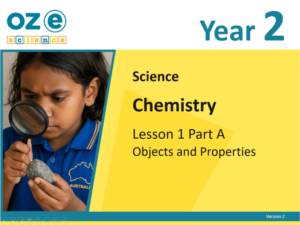
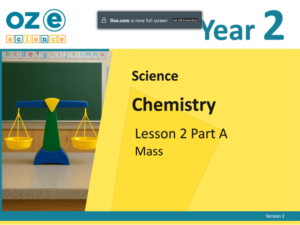
In this unit, students explore physical change while developing scientific inquiry skills like observing, modelling, predicting and testing. They investigate the properties of various materials and how actions such as bending, twisting, crushing, and mixing affect those properties. Students engage in hands-on activities, taking on roles like geologists or pizza chefs to connect learning with real-world scenarios. The unit culminates in an engineering challenge where students apply their understanding of physical changes to enhance materials in a lunch box.
Learning Objectives
In this unit, students learn about:
- objects and the materials they are made from
- physical properties including mass, surface area and volume
- measuring and comparing mass, surface size and volume
- how objects can change shape and size through physical change
- how physical changes affect shape and surface area but not mass
- solid and liquid mixtures
- how material properties make objects suitable for different purposes
- how materials can be changed or combined to improve usefulness
- how engineers test and select materials when designing objects.
Cross-curricular with Mathematics
The unit integrates mathematics through hands-on measurement, comparing quantities, using informal units and organising data. - Students estimate and compare the weight of objects, measure length, mass, and capacity using informal units and record findings in simple tables.
- Students classify and compare shapes and surfaces to describe materials in scientific investigations.
- Students create basic data displays like lists, tables, and simple graphs to organise information from experiments.
- Students use number knowledge to predict totals and compare results across trials.
Assessment
Exit Tickets
Summative Test – Content Assessment and Practical Assessment
Year 3
Unit Overview
Learning Objectives
In this unit, students learn about:
• what matter is and how particles make up matter
• the properties of liquids and solids
• measuring the mass of liquids and solids
• measuring the volume of liquids and solids
• why liquids can flow and change shape
• how to use tools such as scales and thermometers to collect data
• heat energy and temperature
• how melting and freezing change the state of matter
• investigating whether matter changes during melting and freezing
• recording, analysing and communicating scientific observations and results.
Cross-Curricular with Mathematics
This unit integrates mathematics with science through measurement, modelling, symmetry and data analysis.
Students measure length, mass, capacity, duration, and temperature using appropriate tools.
Learners use mathematical modelling to represent and interpret scientific situations.
Data is collected, organised and graphed to analyse patterns.
Assessment
Exit Tickets
Summative Test – Content Assessment and Practical Assessment
Year 4
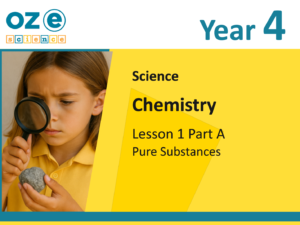
Year 4, Lesson 1A
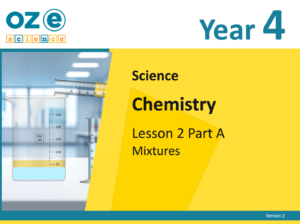
Year 4, Lesson 2A
Teaching Resources
Extra resources
Unit Overview
In this unit, students explore how materials behave under different conditions and their real-world applications. They compare heat transfer in metal, wood, and plastic, examine materials’ resistance to heat and degradation, and model particle arrangements to understand why some substances mix well while others do not. Investigations, such as making slime to study elasticity and creating bioplastics for sustainability, help students grasp material selection for various purposes. The unit culminates in a packaging challenge where students design, test, and refine a prototype to protect medicine supplies based on their knowledge of material properties.
Learning Objectives
In this unit, students learn about:
- pure substances, crystals and mixtures
- how combining materials creates mixtures with different properties
- density and how it varies between liquids
- heat conductivity and how materials transfer heat
- flammability and material safety
- polymers and viscoelastic materials
- decomposition and the development of bioplastics
- selecting materials for specific purposes
- planning, building and testing a design solution
Cross-Curricular with Mathematics
- This unit integrates mathematics with science through measurement, modelling, symmetry and data analysis.
- Students measure length, mass, capacity, duration, and temperature using appropriate tools.
- Learners use mathematical modelling to represent and interpret scientific situations.
- Data is collected, organised and graphed to analyse patterns.
- Work with crystal structures reinforces line and rotational symmetry.
Assessment
Exit Tickets
Summative Test – Content Assessment and Practical Assessment
Year 5
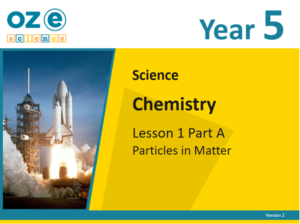
Year 5, Lesson 1A
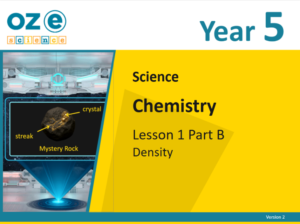
Year 5, Lesson 1B
Teaching Resources
Extra resources
Unit Overview
In this unit, students develop understanding of solids, liquids and gases at a molecular level. Students investigate how gas takes up space, compare properties of elements and compounds and design an experiment to grow crystals. Through experimentation and representation, students observe changes in matter and communicate findings. The unit strengthens skills in investigation, modelling and scientific explanation.
Learning Objectives
In this unit, students learn about:
• how matter is made of tiny particles
• the differences between solids, liquids and gases
• how particle arrangement affects the properties of matter
• measuring the mass and volume of solids and liquids
• density and the relationship between mass and volume
• how liquids flow and why some liquids are more viscous than others
• evidence that gases occupy space and have mass
• how heating and cooling affect the movement of particles
• how melting, freezing, evaporation and condensation change the state of matter
• how substances remain the same during physical changes
• investigating how heat causes liquids and gases to expand
• developing and interpreting particle models to explain scientific observations
• planning investigations, collecting data and identifying patterns and trends
• recording, analysing and communicating scientific findings using tables, graphs and scientific explanations.
Cross-Curricular with Mathematics
- This unit integrates mathematics with science through measurement, modelling, symmetry and data analysis.
- Students measure length, mass, capacity, duration, and temperature using appropriate tools.
- Learners use mathematical modelling to represent and interpret scientific situations.
- Data is collected, organised and graphed to analyse patterns
Assessment
Exit Tickets
Summative Test – Content Assessment and Practical Assessment
Year 6
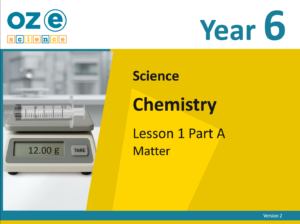
Year 6, Lesson 1A
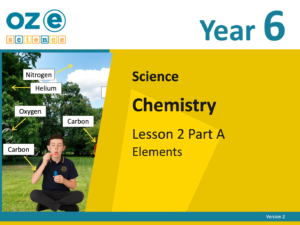
Year 6, Lesson 2A
Teaching Resources
Extra resources
Unit Overview
In this unit, students explore the structure and behaviour of matter, learning that all substances are made of atoms. They read the Periodic Table, understand how elements combine to form molecules and compounds, and investigate how material properties depend on particle composition. Students examine physical and chemical changes, comparing reversible and irreversible changes. Through hands-on activities, modelling and data analysis, they relate observable properties to particle-level processes, explore chemical reactions, and discuss matter conservation. The unit fosters scientific inquiry skills through observation, modelling, predicting, testing and explaining, linking atoms to everyday phenomena like rusting and burning, providing a strong foundation for future chemistry studies.
Learning Objectives
In this unit, students learn about:
- matter and non-matter
- atoms, elements and the Periodic Table
- physical properties including lustre, conductivity and malleability
- changes of state, including melting under different conditions
- dissolving and the formation of solutions
- chemical change and the role of atoms
- conservation of matter
- evidence of chemical reactions
- comparing physical and chemical changes
Cross-curricular with Mathematics
The unit integrates mathematics through measurement data, graphing and numerical reasoning.
• Students use maths skills such as estimating, counting, comparing quantities, measuring length, mass, temperature and recording results in tables.
• Students create bar graphs, line graphs and charts to interpret patterns and changes in scientific data.
• Students apply number skills to calculate totals, compare results and analyse changes over time.
Assessment
Exit Tickets
Summative Test – Content Assessment and Practical Assessment
Other Units
Lesson Design
Lesson Objective
Success Criteria
Activating Prior Knowledge
I Do
We Do
Apple Question
You Do
Revise
Professional Learning
Love what you see? Explore hundreds of FREE lessons in My School Box – join FREE today!
Share this page: