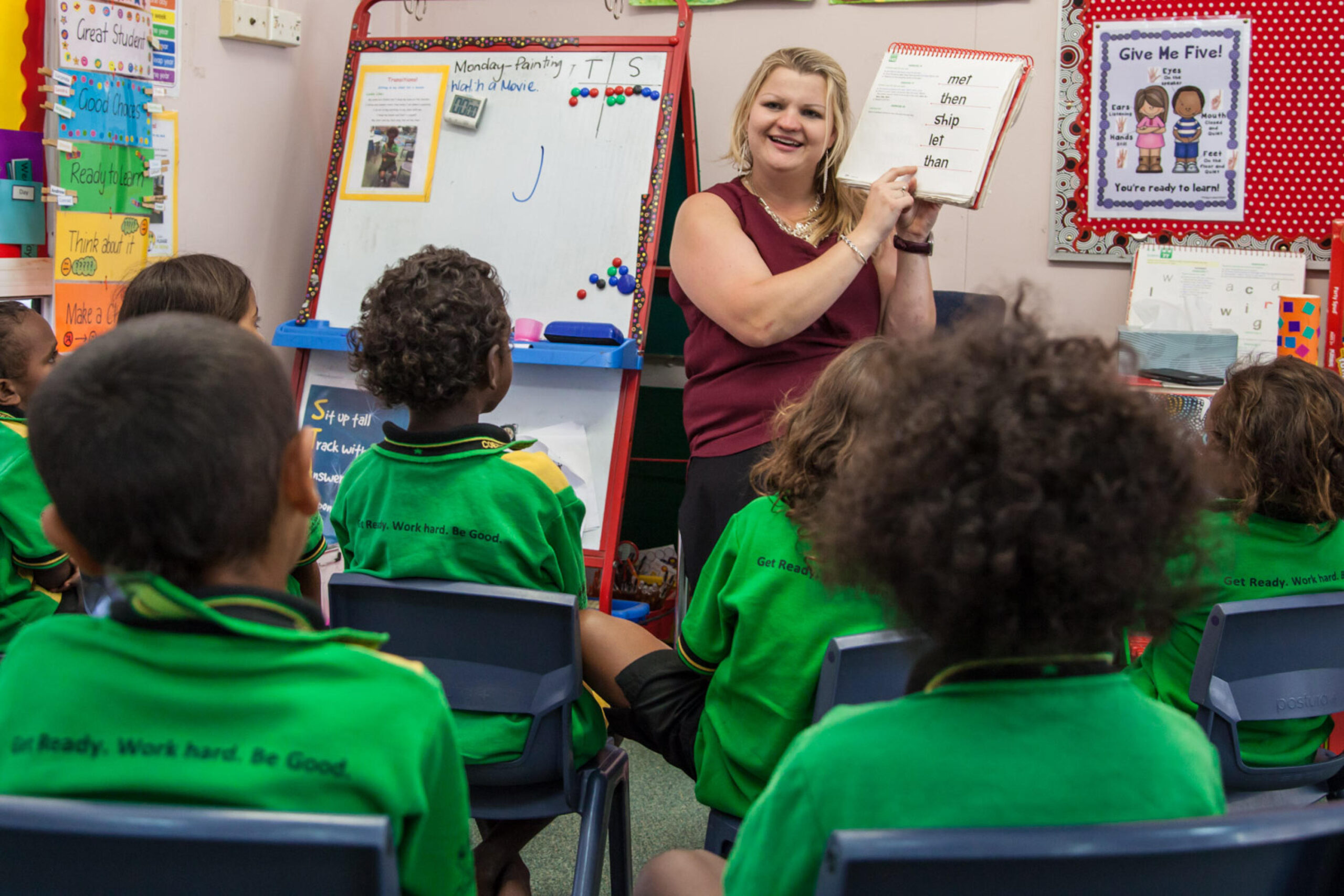
Effective classrooms are places where students know what they are learning and what is expected of them. Teachers explain concepts clearly, break learning into manageable steps and regularly check that students are following along. When students need additional support, teachers respond with further explanation, modelling or practice.
Students are not sitting quietly while the teacher does all the work. They are actively responding, receiving immediate feedback and practising new skills until they can demonstrate mastery.
That is explicit teaching in action.
Explicit teaching does not leave students to work out new concepts on their own. It provides teachers with a practical, evidence-based approach for delivering clear, structured lessons that support every student to succeed. New knowledge and skills are taught step by step, with teachers continually monitoring student understanding and adjusting instruction when needed.
The Australian Education Research Organisation (AERO) identifies explicit instruction as an evidence-based teaching practice that can have a positive impact on student learning. At Good to Great Schools Australia (GGSA), explicit teaching is central to our approach. The goal is not simply to cover content, but to teach effectively, respond to student learning and give every student the opportunity to achieve mastery.
What is Explicit Teaching?
Explicit teaching introduces transparency into the learning process. It clarifies roles. The teacher communicates daily objectives and demonstrates new knowledge while providing guided practice, checking for understanding, and responding to student questions. This turns students into active partners in their learning journey. Not only can teachers use mini whiteboards and whole-class responses, but they can also ask individual questions to ensure every learner is absorbing the information.
The GGSA framework boasts several essential features that work together to deliver great education.
- Achieving mastery before continuing.
- Activation of prior knowledge.
- Active student participation.
- Building foundational skills to complex skills.
- Built-in, regular checks for understanding.
- Carefully sequenced instruction.
- Clear and unambiguous teacher language.
- Immediate feedback.
- Data-informed teaching that spaces practice and repetition.
- Visible learning objectives and goals.
It’s more than I do, we do, now you do. This teaching method is fluid, allowing teachers to respond in the moment, constantly observing, questioning, and correcting in real time. The lesson can move forward once a quick check for understanding confirms they are ready, and if they need additional support, the teacher can provide another example or further scaffold the task.
The Benefits of Explicit Teaching
Everyone benefits from structured and transparent instruction, and one of the greatest benefits of explicit teaching is clarity. Additional benefits include:
Students Who Understand What Success Looks Like
Clear learning objectives provide a destination for students, and when it’s clearly explained from the outset, students can channel their mental energy into the concepts that matter.
New Learning Builds on Existing Knowledge
When the new information logically connects to what a student already knows, learning is less overwhelming. Activating students’ prior knowledge allows teachers to weave lessons seamlessly, facilitating a natural accumulation of knowledge over time.
Students Achieve Genuine Success
Explicit teaching works by breaking complex tasks into manageable pieces, giving students repeated opportunities to succeed, building confidence before they move on to more sophisticated topics and material.
Teachers Know When Students Understand
With regular checks for understanding, teachers can provide students with instant feedback. There’s no need to wait for a high-stakes exam at the end of the unit; teachers can see whether students are keeping pace within the first ten minutes of a lesson.
Knowledge Becomes Fluent
With practice and repetition, skills become second nature, and when the foundational facts are automatic, students have the mental capacity to handle more complex problems. Mastery sets the foundation for a new stage of learning.
Explicit Teaching Strategies
Teachers can draw on a range of explicit teaching strategies to keep students actively engaged, make learning clear and check that students are developing the knowledge and skills being taught.
Establish Clear Learning Objectives
Begin each lesson with a clear learning objective so students understand what they are learning and what successful learning looks like. This helps keep teaching and learning focused throughout the lesson.
Activate Prior Knowledge
New learning is easier to understand when students can connect it to what they already know. Teachers can begin with a short review of prior learning, such as revisiting key vocabulary, using a retrieval activity, reviewing a previously taught concept or practising a prerequisite skill.
Teach in Manageable Steps
Break new concepts and skills into smaller, manageable steps and introduce them progressively, with each step building on what students have already learned. This allows teachers to monitor understanding as learning develops and provide additional support or practice when needed.
Model Clearly
Students benefit from seeing what successful performance looks like. Teachers can model how to pronounce a new or complex word, construct a sentence, solve a problem or analyse a text. By demonstrating the process and explaining important steps, teachers make new learning clear before students are expected to apply it themselves.
Use Clear Instructional Language
Use precise, concise language when explaining concepts, giving instructions and asking questions. Clear instructional language reduces ambiguity and helps students focus on the knowledge or skill being taught.
Check for Understanding
Checking for understanding provides teachers with evidence about whether students are learning what has been taught.
Simply asking ‘Does everyone understand?’ is not enough. Teachers need responses that demonstrate what students know and can do. Strategies can include targeted questions, group responses, paired discussions, short application tasks, brief written responses and demonstrations.
GGSA’s Whiteboards/Chin-it technique, for example, gives students a prompt to respond to on individual whiteboards before revealing their answers at the same time. This allows the teacher to quickly see responses across the group, identify errors or misconceptions and decide whether to continue, reteach or provide additional practice.
Keep Everyone Participating
Explicit teaching is active and interactive. Teachers provide frequent opportunities for all students to respond through questioning, group responses, written work, demonstrations and practice. High levels of active participation give students more opportunities to practise and provide teachers with more information about how well the class is learning.
Correct Errors Immediately
Errors provide useful information about student learning. When an error occurs, teachers should respond promptly with clear, positive correction, then provide an opportunity for the student to practise the correct response. This helps prevent errors from becoming established and allows learning to continue successfully.
Provide Ample Practice
Students need multiple opportunities to practise new knowledge and skills. Teachers should provide guided and independent practice, monitor student responses and give timely feedback and correction. Practice continues until students can demonstrate the knowledge or skill accurately and confidently.
Explicit Teaching is Responsive Teaching
Explicit teaching provides a structured framework, but it leaves room for teachers to rely on their judgment and put their own stamp on things.
Achieving Mastery with Explicit Teaching
Teachers are constantly adapting in reaction to dynamic classrooms, and it has changed the questions they ask themselves at the end of each lesson. Rather than teachers asking if they taught a concept, they ask whether their students learned the concept well enough to use it. AERO guidance allows for reasonable adjustments to cater for subject, age, and context. Mastery takes more than a moment, and teachers can use tests, check independent work, observation, questioning, and progress monitoring. It creates a continuous cycle between teaching, checking, responding, and progressing.
From Knowledge to Automaticity
The more a student practices, the more they become fluent in the task, even if progress is slow and requires considerable concentration.
A student learning multiplication will require considerable mental effort as they begin, but once it is automatic, the next stage of learning can begin. This same concept is applicable to every subject. Fluent decoding supports reading comprehension, the same way automatic letter formation supports writing, and secure vocabulary supports understanding. Students increase their capacity to process complex ideas once they have a strong foundational knowledge.
Leading Schools with Explicit Instruction
Explicit instruction is at its most powerful when it extends beyond individual classrooms. A whole school approach sets the tone for learning in every class, and it means that every teacher is speaking the same language when they discuss teaching. It provides students with greater consistency, no matter what classroom or year level they are in. In addition to curriculum resources, GGSA’s Partner School model provides professional learning, coaching, and school improvement support.
Consistency Without Losing Teacher Expertise
You don’t need to restrict teacher freedom to deliver consistency. The GGSA framework still provides teachers with plenty of freedom to utilise their knowledge, experience, enthusiasm, and student and teacher relationships.
The key is establishing practices that everyone can agree on. For example, as a school, everyone can agree that teachers will use explicit instruction to teach new content, clearly communicate learning objectives at the start of every class, activate prior knowledge, provide immediate feedback, and encourage active participation. Student data can be used to guide decisions, and students should be provided sufficient time to practice for mastery.
Establishing whole-school practices creates a shared foundation that contributes to a more professional culture, centred on continuous learning and refinement.

Partner School Membership and Explicit Teaching
GGSA’s Partner School Membership ties all the components of explicit teaching together for easy whole-school implementation. It provides schools with ready-to-teach curriculum, as well as coaching, professional learning, progress tools, and school improvement support. The model supports schools that want to:
- Align instruction around explicit learning goals
- Build teaching consistency across year levels and subjects
- Establish a united approach to teaching and learning
- Guide improvement using evidence
- Strengthen teacher confidence
- Support implementation through coaching
Every person is important, but they create the most value when they work together.
Explicit Teaching Resources
There’s no need for teachers to translate evidence into classroom resources when GGSA has resources designed to embed explicit instruction throughout the school.
Curriculum Resources
GGSA’s curriculum is ready-to-teach. The resources depend on the program, but typically include teaching guides, complete lessons, assessments, exemplar texts, student workbooks, scaffolded activities, learning-rich sentences, and more. Rather than simply providing a lesson plan, this arms teachers with everything they need.
Schools can explore resources across:
While these resources are useful for every career stage, they are particularly helpful for pre-service and early-career teachers as they provide a practical model of what explicit and affective instruction looks like in action. It saves experienced teachers’ time and allows them to channel their expertise appropriately.
Professional Learning for Explicit Teaching
Knowing explicit teaching principles and applying them fluently are two different professional growth stages, and GGSA’s Professional Learning Modules help educators develop knowledge and techniques to apply these concepts effectively. This learning was designed for teachers, school leaders, teaching assistants, and instruction coaches and the online modules are self-paced to allow educators to learn at their own pace or as part of the school team.
In addition, GGSA provides a learning pathway from technique to practical demonstration. The accreditation model includes 17 practices and 27 explicit instruction techniques. Educators can complete the relevant learning and submit evidence to demonstrate their practice. This creates a progression of learn → practise → apply → demonstrate → refine.

School Improvement Through Explicit Teaching
Explicit teaching takes more than an introduction; sustainable implementation requires commitment, consistent practice, and whole-school support. GGSA’s approach to school improvement connects all the key elements and, over time, becomes familiar and embedded. Rather than being something individual teachers utilise, explicit teaching becomes a major part of how a school teaches.
Explicit Teaching Supports Teachers to Keep Improving
There are different levels of mastery, and when you achieve one, there’s always another level. While one teacher may focus on mastering delivering clear explanations, another may be refining their checking-for-understanding questioning. Every technique a teacher works on can strengthen another. Instructions can guide professional conversations based on classroom observation and data, while leaders can establish systems to ensure the practice flourishes throughout the school.
Related Resources
If your school is strengthening explicit teaching, explore GGSA’s related resources:
Professional Learning Modules: practical learning for teachers, teaching assistants, instruction coaches, and school leaders.
Partner School Membership: connects curriculum, professional learning, coaching and school improvement support across the school.
GGSA’s curriculum resources provide classroom-ready materials grounded in direct and explicit instruction across English, Mathematics, Science, Health and Wellbeing, The Arts and Religion. Together, these resources support educators to move from understanding explicit teaching to confidently applying, refining and embedding it.
Frequently Asked Questions
Is explicit teaching a pedagogy?
Yes, it’s a teacher-led pedagogical approach supported by substantial evidence and recognised by AERO.
Why is explicit teaching important?
It brings clarity to the learning process, ensuring everyone understands their role in the learning process.
Are GGSA resources free to use?
You can become a GGSA Partner School today, completely free and gain access to our wide range of resources.
Make Explicit Teaching Part of Everyday Practice
Explicit teaching is most powerful when it is used consistently, becoming part of the way teachers think about learning. Consider what students need to know, what knowledge they already have, how to explain it clearly, how to check for understanding, what to do if they don’t, how much practice is required, and when they are ready to progress. These questions will keep the focus on learning across the whole school.
Teachers share effective techniques. Instruction coaches help refine practice. Leaders create the conditions for consistency. Curriculum resources provide strong instructional foundations. Professional learning continues to build capability, ensuring students experience carefully sequenced learning that gives them repeated opportunities to succeed.
The purpose behind GGSA’s explicit and direct instruction is clear teaching, active learning, informed decisions and continued practice that moves every student towards mastery.

About Julie Grantham
Julie Grantham brings more than 40 years of experience in education as a teacher, principal and senior public servant, including three years as Director-General of the Queensland Department of Education.
During her leadership, Queensland’s state school results consistently improved and teaching and learning practices were strengthened through the introduction of world-class benchmarking.
Julie also led major reforms requiring every Queensland school to define and implement evidence-based pedagogical practices tailored to their context.
Today, as Director of Schools at Good to Great Schools Australia, Julie works with schools and education systems to design and deliver programs that ensure every student has the opportunity to succeed. Be sure to catch Julie each week as she hosts the Good to Great Schools Webinars. For more information, click the link below.